 BBC Stocks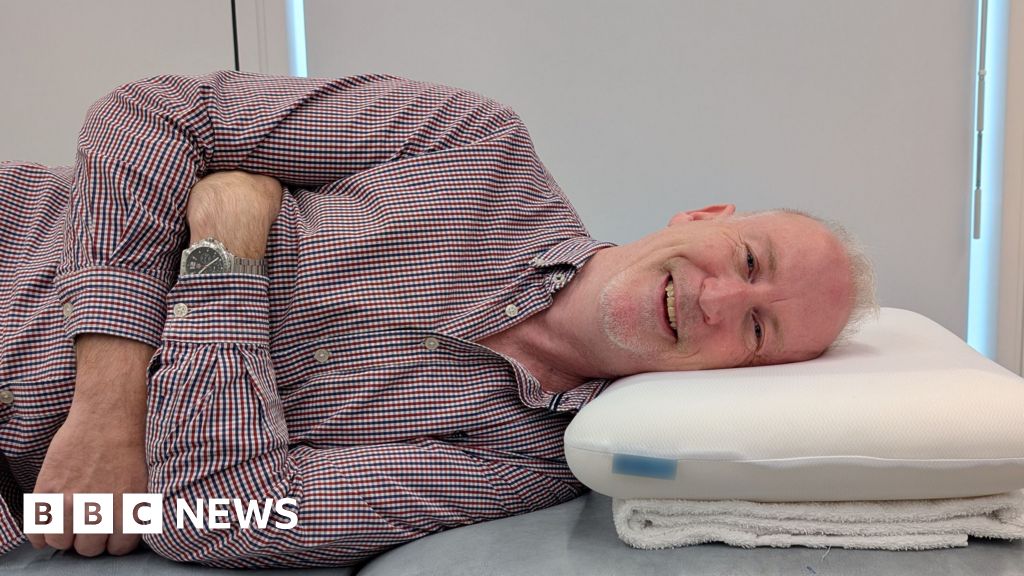
'I take my pillow everywhere': An expert's guide to finding your perfect match 9 minutes ago George Sandeman Chris McCarthy Dr Chris McCarthy says the pillow that's best for you depends on the way you sleep (branding has been obscured) "I am one of those people," says Dr Chris McCarthy. "I do take my pillow with me." You may have seen those people at the airport - a pillow stuffed under an arm as they drag their suitcases to check-in. Or you might be one yourself - attached to a pillow that's soft enough to settle into but robust enough that it's not bunched into a ball by morning.
McCarthy insists he's not being fussy. He's a top physiotherapist and knows the wrong pillow can be a pain in the neck. He doesn't take his abroad, but as soon as he gets to his hotel he starts "faffing about" with the pillows - and he's got a tried and tested trick to make even the most lacklustre one fit for sleep.
Here's his guide to choosing the perfect pillow for you. What kind of sleeper are you? McCarthy, an associate professor at the Manchester School of Physiotherapy, says the right pillow will depend on what position you sleep in.
He tells the BBC's Sliced Bread podcast that most people fall into one of three categories of sleeper: side, back or front. McCarthy discourages front sleeping as your neck is turned one way for a long period of time. "Inevitably a muscle or ligament gets stretched and a bit irritated," he says.
"If there's one thing there's a really good consensus on... in the physiotherapy world about treating spinal pain, it's don't sleep on your front." When choosing a pillow, back sleepers should consider the flexion at the top of their spine, a curving that increases naturally in many people as they age. If you have a bigger bend "it means you need a slightly thicker pillow than someone who's got a very flat back," says McCarthy. For side sleepers the key measurement is the width of your shoulders.
In general, the broader you are the thicker the pillow you will need. But you also need to consider your mattress. How soft is your mattress?
McCarthy says how much you sink into your mattress "makes a huge difference in the subsequent height you then need from the pillow". "Broad shoulders need a thick pillow [if] you're on a very firm mattress," he explains. "If you're on a softer mattress, then you need a thinner pillow because your shoulder sinks into the mattress [more]." This is less of an issue for back sleepers as they don't sink into the mattress as much as side sleepers do.
If your pillow feels too flat, McCarthy suggests placing a folded towel underneath and changing the number of folds to adjust the height. Then you can make a rough measurement to help you pick a new one. What shape is best?
Specialist pillows are often advertised as contoured, ergonomic or orthopaedic - but McCarthy says their effectiveness isn't completely proven. "There is a little bit of fairly scrappy evidence to suggest that having a little bit of a higher front of the pillow, which goes into the neck area... does help [side sleepers]." To see if a higher front helps you sleep better, you can try McCarthy's towel trick by rolling it and placing it underneath your pillow. He urges side sleepers to pick a position that keeps their back straight.
For back sleepers, some manufacturers advertise a pillow with a dip in the middle that is raised at the sides. It does put people into a good sleeping position, says McCarthy, but some of his patients have found them "a bit claustrophobic". Someone who has a large and heavy head also needs a thicker and firmer pillow, he adds.
Feather or foam? Feather and down can keep you cool on warm nights because they wick away heat from your head, says McCarthy. But they can change shape during the night, particularly if the sleeper moves around a lot and the pillow can end up bunched towards the headboard.
"What starts off as a nice, flat, supported surface becomes a wedge and so your neck is then kinked up." Hollow fibre and microfibre fillings can hold shape better though they generally don't wick away heat as well, says McCarthy. Some are made with a firmer material in the lower half of the pillow, which help retain the shape during the night. McCarthy bought his foam pillow, which has tubular spaces for ventilation, five years ago for about £50.
As a side sleeper, he adjusts its height using a folded towel laid underneath it. He says choosing the right pillow is very much "horses for courses" and encourages people to utilise the trial period some manufacturers offer customers. "There just isn't a one-off design that is perfect for everybody or every position, I'm afraid," he says.
"You really have to personalise it." Other stories you may enjoy
Source: BBC